
PRAXIS-NW
Vision Statement
We believe lasting change starts with naming what's true before acting on it. Structural honesty — protecting people, refusing to mistake comfort for clarity — is what makes durable change possible, instead of fixing only what's visible on the surface.
Mission Statement
PRAXIS-NW helps leaders see the structural conditions shaping their organizations — the conditions usually misread as people problems. We give them the language and discipline to detect, diagnose, design, and develop those conditions, so the people inside the system stop carrying the cost of what the system itself was built to produce.
Our Canon
A shared language for seeing what's really driving your organization.
Our Commitments

What we stand for
What We're Building Toward
A world where the conditions shaping people's experience inside organizations are visible, nameable, and able to be redesigned — so leaders can govern with real clarity, practitioners can do this work with real protection, and no one is left quietly carrying what honest design should have held.
How We Carry That Out
PRAXIS-NW gives leaders, practitioners, and the people inside these systems a shared way to see what's really happening — and the tools to act on it. We help leaders govern with more clarity, give practitioners language and protection for the work, and help people name what they're experiencing instead of carrying it alone. The goal is always the same: catch problems upstream, redesign what's producing harm, and know when to walk away with integrity if a system can't hold honest work.

Ethics Statement
The PRAXIS-NW Institute is governed by a commitment to truth, structural honesty, and the protection of people inside systems. We refuse to normalize conditions that conceal risk or displace responsibility. We refuse to let people absorb what design should hold. We treat naming, pausing, and ethical exit as acts of care — not failure. Making the invisible visible is not optional. It is the foundation of every honest institutional act.
Governance Doctrine
Governance is the structure that determines how authority, accountability, responsibility, risk, and decision‑making move through a system.
PRAXIS‑NW holds that:
-
Authority must be clear
-
Responsibility must align with authority
-
Risk must be placed honestly
-
Escalation must move issues to the level that can act
-
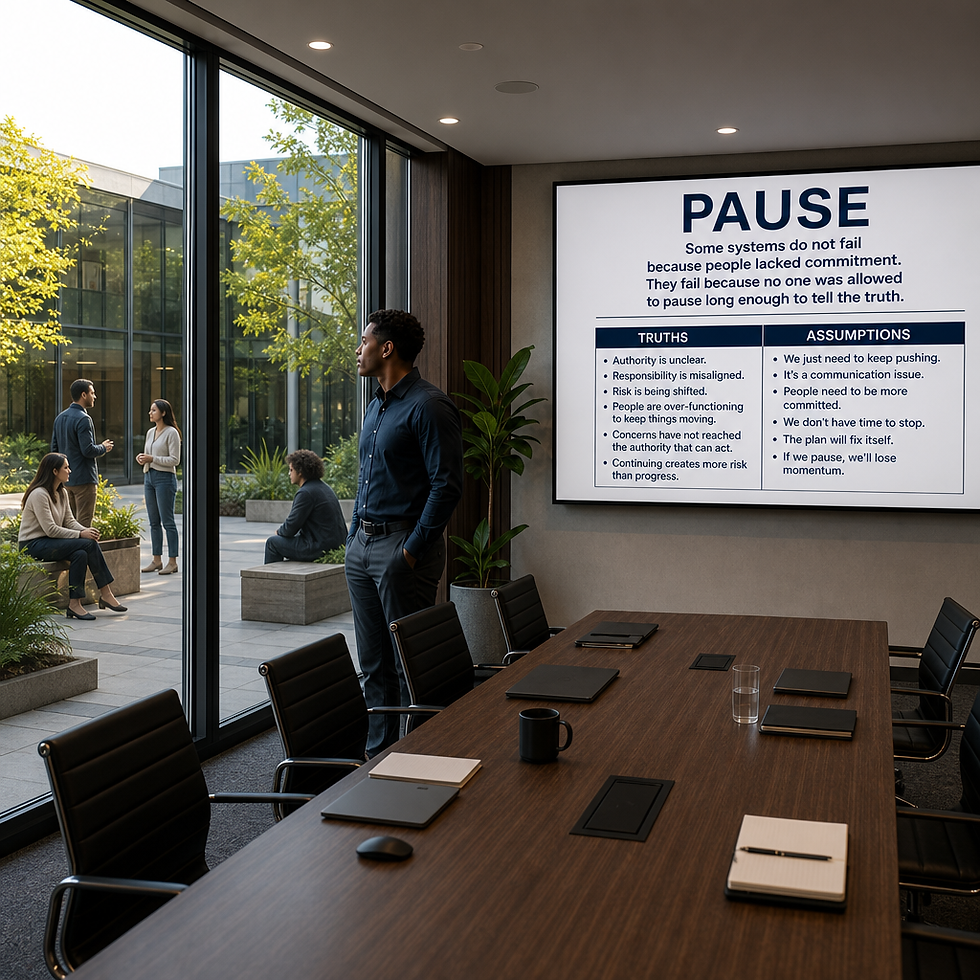
Pausing is a governance function
-
Systems must hold what people should not be asked to absorb
This doctrine anchors all PRAXIS‑NW work.
Impact Statement

PRAXIS‑NW measures impact by structural change, not activity. Impact is present when systems reliably produce clarity, protection, aligned authority, and honest risk placement.
Positioning Statement
PRAXIS‑NW Institute works upstream — before burnout, before misalignment, before systems fail. We are not HR, not OD, not culture work, and not a behavior‑fixer; we design the conditions that make those functions hold.
Collaboration Statement
PRAXIS-NW collaborates only where authority, accountability, and risk are honestly shared. Partnership is defined by structure, not by language.
Leadership Philosophy
Leadership is not motion. Leadership is the discipline to stop, see clearly, and realign conditions before continuing.
Boundary Statement
PRAXIS‑NW Institute does not participate in processes where authority is unclear, risk is displaced, or conditions are not aligned with the responsibilities being asked of people. We do not lend legitimacy to structures that cannot hold the work.